I've been debating whether or not to do any videos featuring modern performers. I don't want to encourage anyone to use their acts, but at the same time, I sometimes find it highly motivating to see what fantastic things are being done on the scene. So, I've decided after a lot of consideration that I will feature a few people, every now and then. Especially when I can't help but share because they are SO COOL.
This is Roxy Velvet, a British burlesque performer who does a fantastic birdcage bit with fans and lyra--a type of aerial performance with a suspended hoop. I've seen lyra done for burlesque before, and it's great, but the concept of the birdcage is what truly makes this. I feel like that's honestly possibly one of the most important things about burlesque acts: if the concept is good, your number is almost automatically ten times better.
Take a peek!
Friday, July 15, 2011

Tuesday, July 12, 2011
Art and the Circus
At the moment, I'm really into the idea of doing a sort of abstract set--scaffolding with little decoration and a couple of circus wagon flats--so that the show could be in any time and place, like a real circus travels. This is slightly out of character, since I'm usually not into abstract art. But some of my favorite artists are Impressionist or post-Impressionist, and so rather than calling my ideas for the set 'abstract', I'm going to say 'impressionistic'.
Regardless, I've found that a lot of my favorite artists were also inspired by the circus. Here are some of my favorite works!
Degas:
Lautrec:
Tissot:
Picasso:
Chagall:
Seurat:
Here are a few more--not necessarily by artists I already liked, but that popped up when I was looking for the others and struck me.
Regardless, I've found that a lot of my favorite artists were also inspired by the circus. Here are some of my favorite works!
Degas:
 |
| Miss La La in Circus Fernando |
 |
| Rider at the Circus Fernando |
 |
| Acrobats at the Circus |
 |
| At the Circus Dressage |
 |
| Women of Paris: The Circus Lover |
 |
| Au Cirque |
 |
| Circus Family |
 |
| Seated Harlequin |
 |
| The Circus Horse |
 |
| The Circus |
 |
| Circus Boy 1872, Antonio Mancini |
 |
| Circus Procession, Victor Anderson |
 |
| Untitled [circus performers], Franze Kline |
Lydia Thompson
Today's featured burlesque artist is Lydia Thompson, who is credited with starting the popularity of burlesque in the US in the late 19th century with her troupe.
Thompson was born in London in 1838, and began her career at 14 when she left home to become a dancer. As a member of the corps de ballet of Her Majesty's Theatre, Thompson gained acclaim for her dance roles in numerous pantomimes and burlesques. (Note: burlesque in the 19th century more closely followed the root of the word, and were farcical productions spoofing popular topics and celebrities of the day.) Thanks to her growing fame, Thompson toured throughout Europe for three years. She was considered a talented dancer as well as being known for her vivacious personality and charm. Her performances there ranged from ballet-burlesque to traditional dances, such as the Hornpipe and Highland Fling. She returned with a very good international reputation to continue performing in England in 1859.
Throughout the next few years Thompson continued to act and dance in burlesques, both in London and on provincial tours. She was also known for her roles as the 'principle boy'--the leading male character in the piece. In 1868 Thompson and her second husband sailed to New York with her troupe, called The British Blondes. They were the most successful new theatre enterprise that season, thanks to the combination of comedy routines, scandelous costumes, cross-dressing, satire, bawdy humor, variety acts, and improvisation popular in British burlesque at the time. The British Blondes's first successful foray into American theatre was extended from six months to six years, garnering both high praise and criticism for their performances.
Unlike praise for the group, which focused on the talent of the girls and content of the performances, critiscism focused on the morality of those involved. One particular critic, Wilbur Storey, had an ongoing back-and-forth with Thompson and her troupe. He claimed not only that the show transgressed propriety, but also questioned the virtue of the performers. In response, Thompson, her husband, and Pauline Markham (one of the most successful troupe members) horse-whipped Storey at gunpoint in 1870, for which they were arrested (but later released after a fine). The incident only increased the popularity of the troupe.
Thompson returned to England in 1874, but continued to perform in America for the next twenty years. In 1899 a benefit was held in her honor in London, where she recited a rhyming farewell address to the theatre community written by W. S. Gilbert (lyricist of the operetta team Gilbert and Sullivan). In it, she reminices about the community she has been a part of:
But when I say “Good-bye” in faltering tone
To you--the truest friends I’ve ever known--
The friends whose warmth expressed in gladdening chime
Supplied the sunshine of my summer-time--
The case is somewhat different. You see,
I’m losing you—-you’re only losing me!
But this won’t do at all—-I’m off the scent,
My line’s light comedy, not sentiment.
My future tense seems cheeriness to lack,
And so, I won’t look forward—-I’ll look back.
(you can read the address in its entirety here)
After this Thompson mostly went into retirement, but she did perform again in 1904.
Thompson's British Blondes spawned several new burlesque troupes in the US, and their combination of satire, gender-bending, dance, and scandalous costumes (I once heard Thomson's troupe described as 'buxom-thighed') have all remained part of the American burlesque scene to this day.
She's definitely someone I'm taking heavy inspiration from as I approach this show...although I seriously hope I don't have to horse-whip anyone for questioning my girls!
 |
| Lydia and her girls |
 |
| Thompson dressed for the Hornpipe |
 |
| Poster from a British Blondes show |
 |
| Lydia Thompson's portrait on sheet music of a song written for her troupe |
Unlike praise for the group, which focused on the talent of the girls and content of the performances, critiscism focused on the morality of those involved. One particular critic, Wilbur Storey, had an ongoing back-and-forth with Thompson and her troupe. He claimed not only that the show transgressed propriety, but also questioned the virtue of the performers. In response, Thompson, her husband, and Pauline Markham (one of the most successful troupe members) horse-whipped Storey at gunpoint in 1870, for which they were arrested (but later released after a fine). The incident only increased the popularity of the troupe.
 |
| Pauline Markham, a member of the British Blondes, in costume |
But when I say “Good-bye” in faltering tone
To you--the truest friends I’ve ever known--
The friends whose warmth expressed in gladdening chime
Supplied the sunshine of my summer-time--
The case is somewhat different. You see,
I’m losing you—-you’re only losing me!
But this won’t do at all—-I’m off the scent,
My line’s light comedy, not sentiment.
My future tense seems cheeriness to lack,
And so, I won’t look forward—-I’ll look back.
(you can read the address in its entirety here)
After this Thompson mostly went into retirement, but she did perform again in 1904.
Thompson's British Blondes spawned several new burlesque troupes in the US, and their combination of satire, gender-bending, dance, and scandalous costumes (I once heard Thomson's troupe described as 'buxom-thighed') have all remained part of the American burlesque scene to this day.
 |
| lithograph for Thompson's jokey dance from the V&A collection |
Friday, July 8, 2011
Through the Lens of Walker Evans
Walker Evans is, I think, most famous for his photographs capturing life during the Great Depression across the US. However, during that time he also took many photographs related to the circus, and these almost gritty black and white images are exactly what I think of when I think about the atmosphere of this show. I guess you could say I'm aiming for a black and white photograph come to life in full, sparkling color that the audience can walk right into.
Here are a couple of Evans' images. All of his images belong to the New York Metropolitan Museum of Art (click the link to view them in the online database).


You can read more about Walker Evans here if you're interested-I recommend it!
Here are a couple of Evans' images. All of his images belong to the New York Metropolitan Museum of Art (click the link to view them in the online database).


You can read more about Walker Evans here if you're interested-I recommend it!
Thursday, July 7, 2011
Sally Rand
Rather than write one history post about burlesque, I'm going to feature artists that have added to the inspiration for this show individually. First up is the fantastic Sally Rand!
Born Helen Beck in 1904, Rand left her home in the Ozark region of Missouri to join a circus in her teens. She went on to be a cigarette girl, model, chorine, and performer with Ringling Brothers! In 1927, after performing in a series of stage shows and silent films, she was selected to join Cecil B. DeMille's company for feature films. Her career as a film star ended with the onset of 'talking pictures' because of her lisp.
 A lot of wit and creativity led Rand to create her most famous dance, involving two feather fans (and not much else)! Her teasing 'fan dance' gained her great success in the burlesque world, and a steady job as a performer at the Paramount Club in the 1930s. In 1933 she even appeared at the World's Fair-and was arrested multiple times in one day for indecent exposure!
Rand continued her success with other acts, including a 'bubble dance' with a huge transparent bubble. In all of her acts, Rand embodied the tease as a central part of her dance--something I consider a huge part of the modern art of burlesque. Rand also performed in traditional plays in the 1930s as Sadie Rand, and even starred opposite Humphrey Bogart.
Still probably one of the most well-known burlesque stars, Rand performed several times after her retirement, including in the 1978 show This Was Burlesque. She died a year later in 1979.
A lot can be done with simple props and good lighting. Sally Rand knew that-and it's evident in her lovely 1934 fan dance. What you don't show is often more exciting than what you do!
And finally, a celebrity game show that also featured Gypsy Rose Lee (stay tuned, I'll post it) called What's My Line?:
 |
| Sally Rand |
Rand continued her success with other acts, including a 'bubble dance' with a huge transparent bubble. In all of her acts, Rand embodied the tease as a central part of her dance--something I consider a huge part of the modern art of burlesque. Rand also performed in traditional plays in the 1930s as Sadie Rand, and even starred opposite Humphrey Bogart.
Still probably one of the most well-known burlesque stars, Rand performed several times after her retirement, including in the 1978 show This Was Burlesque. She died a year later in 1979.
A lot can be done with simple props and good lighting. Sally Rand knew that-and it's evident in her lovely 1934 fan dance. What you don't show is often more exciting than what you do!
And finally, a celebrity game show that also featured Gypsy Rose Lee (stay tuned, I'll post it) called What's My Line?:
Look Book 2 *NSFW*
I have another post I'm working on about the history of burlesque, since it's an interesting parallel to the similarly-timed history of Ringling that I posted earlier today. In the meantime, here are some pictures from early burlesquers ranging from the late 19th century through the 1950s. How fabulous are these women? I want to be draped in nothing but fur...
 |
| Bobo Britt, mid-20th c. |
 |
| unknown performer, 1920s |
 |
| 1880s cancan girls from the Moulin Rouge (not burlesque, but still fabulous) |
 |
| comedy musical burlesque troupe members (from left) Faye Templeton, Lew Fields, Joe Weber, and Lillian Russell |
 |
| Pauline Marham, one of the original 'British Blondes' |
 |
| Sally Rand, 1930s pioneer of the modern fan dance |
 |
| Violet Craig, early burlesque performer with her 'Wild West' act |
 |
| Miss Zorita, early/mid 20th c. performer |
A Brief History of Ringling Brothers and Barnum and Bailey Circus
Most of the show posters I've been looking at recently are all from the combined Ringling Brothers and Barnum and Bailey Circus, which has been performing for over a century. They're still around, and I highly recommend going to see them! There's also a musical based on P.T. Barnum, the man behind it all, called-what else?-Barnum.
On an almost-burlesque-related note, Barnum actually started in the side show business, with Barnum's American Museum rather than the three-ring circus we associate with him today. He first gained success in the 1840s with 'curiosities' such as General Tom Thumb (a midget), the Fiji Mermaid, and conjoined twins Chang and Eng Bunker.
Unfortunately for Barnum, although his museum was successful, it burned down twice. With too much debt to stop, he continued on in the business by taking on partners/financial backers. In 1881 he joined with James Bailey, creating the Barnum and Bailey Circus. After Barnum's death in 1891, Bailey bought Barnum's half and continued to tour.
In the meantime, back in the Midwest, five of August Rungling's sons founded the Ringling Brothers Circus in 1884. Smaller than Barnum and Bailey's endevor, the show still gained moderate success and traveled throughout the US.
In 1907 Ringling Brothers Circus bought Barnum and Bailey, touring the shows separately for several years. However, as the brothers died, it became harder and harder to manage two touring circuses. Finally in 1919 the remain two Ringling brothers combined the shows into Ringling Brothers and Barnum and Bailey Combined Shows, which debuted in Madison Square Garden.
Over the next two decades, the enterprise continued to grow as smaller circuses felt the hit of the stock market crash and the following depression. Many of these were purchased by John Ringling. Popularity and success for the circus continued through World War II, during which President Roosevelt gave the show special permission to use the railroads.
As Hollywood grew and the popularity of live shows decreased during the 1950s, the travelling circus also began to suffer. Ringling Bros. and Barnum and Bailey Combined Show had their last performance in 1957, almost 50 years after the show's debut.
Since then, Ringling has been purchased and is up and running again. While there is still a lot of controversy surrounding the use of animals in circus performance, the modern circus offers a wide variety of both traditional and uniquely modern circus acts. Ringling Bros. and Barnum and Bailey Circus is on tour now-go and check out a show for yourself! You'll be entering into a tradition centuries old when you do.
On an almost-burlesque-related note, Barnum actually started in the side show business, with Barnum's American Museum rather than the three-ring circus we associate with him today. He first gained success in the 1840s with 'curiosities' such as General Tom Thumb (a midget), the Fiji Mermaid, and conjoined twins Chang and Eng Bunker.
 |
| Stratton, aka General Tom Thumb, with a guardsman |
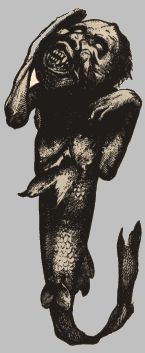 |
| a sketch of Barnum's Fiji Mermaid, c. 1841 |
 |
| Poster for Barnum and Bailey Circus-A Child's Dream |
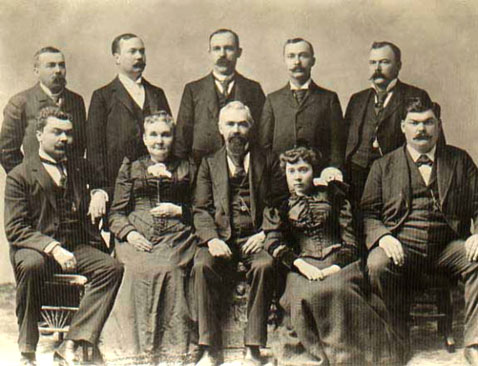 |
| the Ringling family |
 |
| 1898 Ringling Brothers poster |
In 1907 Ringling Brothers Circus bought Barnum and Bailey, touring the shows separately for several years. However, as the brothers died, it became harder and harder to manage two touring circuses. Finally in 1919 the remain two Ringling brothers combined the shows into Ringling Brothers and Barnum and Bailey Combined Shows, which debuted in Madison Square Garden.
Over the next two decades, the enterprise continued to grow as smaller circuses felt the hit of the stock market crash and the following depression. Many of these were purchased by John Ringling. Popularity and success for the circus continued through World War II, during which President Roosevelt gave the show special permission to use the railroads.
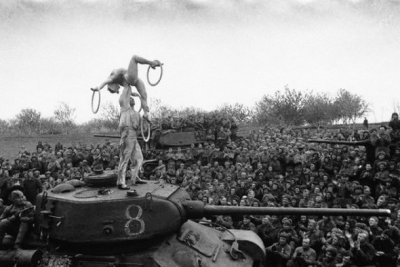 |
| troops watch circus performers during WWII |
Since then, Ringling has been purchased and is up and running again. While there is still a lot of controversy surrounding the use of animals in circus performance, the modern circus offers a wide variety of both traditional and uniquely modern circus acts. Ringling Bros. and Barnum and Bailey Circus is on tour now-go and check out a show for yourself! You'll be entering into a tradition centuries old when you do.
Subscribe to:
Comments (Atom)